
AI and the Battle for Jobs: Threat or Opportunity for Workers?
- Nov 18, 2024
- 3 min read
Updated: Dec 17, 2024
The role of artificial intelligence (AI) in the workforce is growing at a remarkable pace. What once sounded like science fiction has become reality: robots handling tools and software performing complex office tasks. But how do technologies like Tesla’s Optimus or Claude AI genuinely reshape the working world? Are we witnessing the end of traditional employment or the dawn of new opportunities? A closer look reveals that the situation is anything but simple.
1. AI in Action: Tesla’s Optimus and Claude as steersman
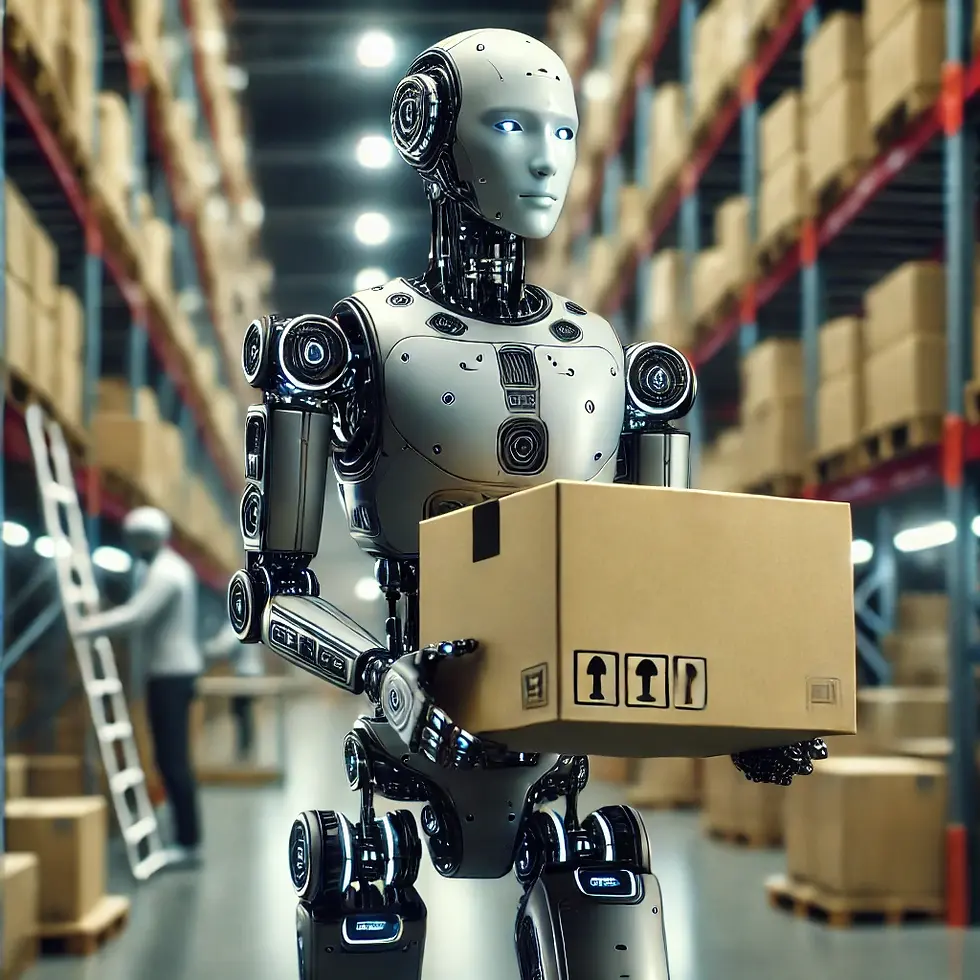
Tesla’s humanoid robot, Optimus, exemplifies a vision of AI that extends beyond pure software. Elon Musk describes it as a potential game-changer for industry and everyday life. Optimus can perform tasks like carrying heavy loads, precision work, and navigating unstructured environments. Its ability to handle human tools makes it particularly attractive for manufacturing, logistics, and maintenance.
Why is this revolutionary? Unlike specialized industrial robots, Optimus can learn and adapt. For instance, instead of driving a forklift, such a robot could directly move pallets—without requiring lunch breaks. Musk envisions Optimus as the "worker of the future," a concept that could be vital for industries facing labor shortages, such as healthcare, where physically demanding tasks could be automated.
Equally impressive is Anthropic’s Claude, the first AI capable of operating computers autonomously. Claude can sort files, draft emails, or sift through databases—tasks traditionally reserved for humans. In administration, it has the potential to unburden entire departments. But this raises a critical question: Are machines destined to become competitors or collaborators?
2. The Data Landscape: Are Jobs at Risk?
A look at current studies paints a mixed picture. According to the OECD’s AI-WIPS report (Work, Innovation, Productivity, and Skills), AI primarily automates repetitive tasks, increasing the demand for highly skilled workers. Among companies adopting AI, 64% invest in upskilling their workforce, while only 17% report layoffs.
However, the long-term effects remain contentious. McKinsey estimates that by 2030, up to 800 million jobs worldwide could be replaced by automation. The most vulnerable professions are in production, transportation, and administration. Yet, this trend also has an upside: an estimated 130 million new jobs could emerge in fields like data management and AI training.
3. New Opportunities: Highlighting Human Strengths
While machines take over many tasks, there are areas where humans remain indispensable. Jobs requiring empathy, creativity, and complex decision-making are likely to benefit from automation. For instance, healthcare workers could spend more time with patients if AI handles administrative duties. Designers and developers could harness AI tools like Claude or ChatGPT to streamline routine work, allowing for greater focus on innovation.
Another growing field is that of "AI trainers," professionals who oversee, test, and refine AI systems. Demand for such roles is skyrocketing as more companies adopt AI. These jobs require not only technical expertise but also the ability to align human needs with technological solutions.
4. Optimus and Co.: The Social Impact
The implications of robots like Optimus are not just economic but also social. Integrating machines into human environments raises questions of safety, ethics, and acceptance. In many industries, especially manufacturing, robots could ease workloads but also create social tensions if workers feel their jobs are at risk.
Elon Musk emphasizes that robots like Optimus could improve quality of life by freeing workers from monotonous or physically taxing tasks. However, the success of this vision depends on its implementation. Will the profits from automation be equitably shared? Or will they primarily benefit a few large corporations?

5. Looking Ahead
One can only hope that robots not only work efficiently but also respect office traditions. Will coffee still be warm in the break room? And will robot colleagues master the art of small talk someday? Jokes aside, humans will remain central to the workplace - not despite but because of AI. It is a tool, not a replacement.
At least for the coming decades. By 2050, researchers predict the emergence of a new type of AI. After the "Narrative AI" era up to 2015 and today’s "Broad AI," capable of handling complex tasks, the arrival of "General AI" is expected around mid-century. Such systems could surpass human intelligence in many respects, understanding and even mimicking human emotions. This advancement might bring sweeping changes to service industries, putting more jobs at risk.
Conclusion: A Delicate Balance
AI and robotics are set to irreversibly transform the world of work. The key lies in fair and sustainable integration. Upskilling and collaboration between humans and machines can ensure that technological progress benefits everyone.
For those considering a career change, incorporating AI skills is a must. Free online courses, such as IBM’s Artificial Intelligence Fundamentals, offer excellent opportunities to gain relevant knowledge and certifications, enhancing job prospects in an AI-driven market.


Comments